
Q- Mommy, why is that man playing with his gusle?
A- Ask your father, dear.
You are not logged in. Please login or register.
Guitar chord forum - chordie → Posts by jerome.oneil
Q- Mommy, why is that man playing with his gusle?
A- Ask your father, dear.
The American counterpart...

Well, it's certainly popular, and has been going back the baroque period. But there are reasons for that. It's relatively easy to play, it resolves well, and provides a simple framework for improvisation.
There's absolutely nothing wrong with mixing it up as you do.
I love these chords. How many chords allow you to play four different chords at the same time without even moving your hand.
What's that you say? How can this be? (I just got my head wrapped around this, so bear with me....)
Lets take a look at what I'm talking about first.... A diminished 7th interval relationship is I bIII bV bb7. That's a "double flat" 7th, or as we humans like to call it, the major 6th.
Lets use Bdim7 as our example.
The notes in Bdim7 are B D F Ab.
Now lets take a look at the notes in the dim7 chords for all the other notes in Bdim7.
Ddim7 is D F Ab B
Fdim7 is F Ab B D
Abdim7 is Ab F B D
So that's four chords that all share the *exact same notes.* So what that means is if you are fretting Bdim7, and the next chord is supposed to be a Ddim7, don't move. You're already playing it.
The other great thing about these chords is that they are eminently movable. You can slide up the neck but a few frets, and be playing a new voicing of the same chord, unlike the major and minor triads we are all familiar with. Here's an example. B/D/F/Abdim7 in 4 places on the neck. All the same notes, all the same intervals.

So how can that be? It's because the intervals between any two consecutive notes in the chord are all the same, minor 3rds. If you keep stacking minor 3rds on top of it, you won't get any new notes, as you would if you were using major or minor triads. There is no such animal as a "diminished 9th." All that would do would be to add the root back onto the chord. In this way, the chord is "symmetrical."
So where can you use these nifty little chord shapes? They go well over minor keys, so long as the key is one of the notes in the chord.
Handy!
It's a fun place to play. Very much a hole in the wall. We've played weeknight gigs there but this is the 1st time we'll be there on a Saturday, so we wanted to do it right.
Funny thing is, in desperation I had stuck out a craigslist add in the musicians section. 10 minutes after I posted it, my buddy calls and says he'll take the stage time.
Timing is everything.
Tacoma is about 30 miles south of Seattle, Washington.
You'll name your band through apathy. Thats how it happened for us. We all enjoy playing together. We're all in it for the same reasons. No one wants to be a rock star. No one really cares what the name is.... until someone comes up with a name.
The rules began to fall in place as names started being proposed...
1. Had to be thought of by a human. We had a pretty cool one generated by a machine. Vetoed...
2. No "The X and the Ys" Vetoed about a dozen options.
3. No verbs. "Counting Crows." "Stabbing Westward." That kind of thing. Vetoed a half dozen...
4. No "The Xs" Took out a bunch more.
5. Nothing making any kind of overt statement. We didn't want to be a social movement. We just want to play.
6. Etc...
This went on for months. Finally, we settled on "A Close Second." Found about six other bands on mySpace with the same name. We didn't care. We figure if anyone gets big enough to afford a "Cease and Desist" lawyer, we'll change it again. So that's what we're going with. Because nobody cares. 
So we have a gig coming up on Saturday at a local bar. Owner wants three hours. We have two solid hours, and another forty five minutes of messing around, so since it's a paying kind of thing, we decide to bring in another group to do a 1st set. Split the check, tip jar, etc..
And they can't do it.
So we're scrambling...
Just got a couple of guys I know to sit in for them.
Ahhh.... relief.
Garth puts on a show.
Now, having said that, I don't know if he killed country music (not dead as far as I can tell) but he's probably wanted for questioning in the assault.
My advice would be to stop learning other people's songs, and learn about your instrument instead. Start writing your own songs. That will force you to think differently about the instruments. What chord do I start on? How do I construct an interesting melody? Where do I go from here? That will challenge you to get outside your head, and learn to play the guitar, rather than play songs.
You should feel great! Those Korg Panda's are hot little boxes.
Regardless, if you want to improve, the best way is to figure out what you want to improve on, come up with a practice regimen to exercise that skill, and then be disciplined enough to hold too it.
Scales were invented (discovered?) by Pythagoras. He figured that whole square of the hypotenuse thing wasn't annoying enough, so just after he went about making playing with shapes a whole lot more complicated with sins and cosins and squares of this and that, he went about complicating learning about music with twelve tones that only have eight names but two modifiers and making sure some of the names and modifiers are completely different but describe the same thing. At least we don't have to square F#m and then compare it to the sum of the squares of A and Cmaj. And he used a precursor to a hammer dulcimer to figure this stuff out, so he NEVER had to finger an evil B chord. And it shows, man. It shows.
- Zurf
Hey man, we got it easy. There are eastern music systems out there with 16 and 18 note scales. Imagine having to deal with quarter tones.
Ook!
Someday I'll figure out that hypotenuse thing. Then my life will be complete.
Sorry for my absence. Been traveling abroad, and working like a dog as of late.
Where to start?
Scales. Major scale patterns. Learn them inside and out. They are the foundation for everything you will do as a musician.
Alvee,
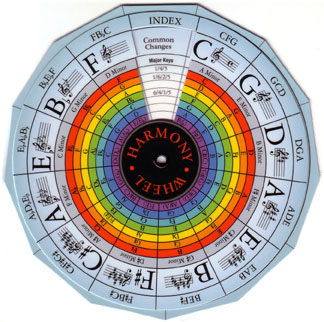
Here's some very practical, useful information regarding harmony and the application thereof. You'll have to squint to see the notes on the wheel and I'm sure some computer savy people can figure out a way to enlarge the harmony wheel.
That's a handy little device. It's a good visual representation of scales, and how they work. If you start at the outside of the ring, and work towards the center, you are looking at every note in that key's major scale.
That, applied with the scale patterns we all love so much, and you should be jamming in any key at any time, anywhere.
weren't scales invented by music teachers to anoy wanna be guitar players,
Hah!
It may seem that way at first, but after it clicks, you'll wonder how you ever got along without it.
Good luck!
Am and C major are the same key signature. Anything that works in C will work in Am.
This is pure theory. If you know which key they are in, and are capable of playing scales related to that key (and you are) then improvising and jamming with folks becomes easy.
Chord progressions originate with scales.
The I IV and V refer to chords named by the 1st, 4th, and 5th notes of a major scale.
G Major scale, for example
G A B C D E F# G
The "in key" chords for this scale would then be
G Am Bm C D em F#dim G
So the I IV and V would be
G C D
Scales scales scales...
Grabbing a key signature is somewhat of a guessing game until you're familiar with chords and how they relate to scales.
A good rule of thumb is to know the I IV and V's of all keys, which isn't hard to figure out.
For example, if you see a lot of F, C, and G, you could surmise that the song is in the key of C, as C F and G are the I IV and V of C major.
A study of common chord progressions is also useful in figuring this out. They call this the "tonal center" of a song.
Just a bit of trivia on the all the birthdays.
The song "Happy Birthday" is owned by the Warner Chapple company, and public performances of it are a violation of copyright unless royalties are payed. It's why you never hear it sung on TV.
Pretty dumb, eh?
The cappo allows you to transpose and play songs with the open chord shapes. This is particularly usefull in country and bluegrass numbers, where the guitar parts are all very similar. You can move the key from whatever the root is and not have to do anything different.
And to second Jame's point, there are no dumb questions.
Well, a "blues" scale is traditionally a variant of a minor scale. So what you really want is the scales and chords that play well over G minor.
G is the VI of the E major scale, so you can play it over E major and be OK.
It's not all that complex. I just got back in town and when I have myself sorted out, I'll put together a post on it.
If you can play a major scale, you can play myxolydian mode.
Start playing on the 5th note, and play all the way through to the octave. Presto: Myxolidan.
Modal scales are all based on that pattern.
I - Ionian (a.k.a. Major scale)
II - Dorian
III - Phrygian
IV - Lydian
V - Myxolidian
VI - Aolean (a.k.a. Minor scale)
VII - Locrian
You can't just play any scale over any chord though. You should know when it's appropriate to play a minor scale, or a myxolidian scale, or whatever.
Myxolidian plays well over Dominant 7 chords.
Well that depends I guess. Which pentatonic form? Do you want to play only in one "box?" Does it fit the song you're playing to do that?
Guitar chord forum - chordie → Posts by jerome.oneil